

SEO has traditionally asked a fairly straightforward question: Can the right person find your page when they search?
Generative search adds another one:
When someone asks an AI system for help, will it understand enough about your brand to mention or recommend you?
Generative engines don’t simply return ten blue links. They retrieve information, compare sources, synthesize answers, and decide what information deserves space in the final response. The original Generative Engine Optimization research by Aggarwal et al. formalized this difference and built GEO-bench around 10,000 queries because traditional ranking metrics alone don’t adequately describe visibility inside generated answers.
So, while SEO is still foundational, GEO introduces a different objective. I’ve covered the bigger shift in how AI SEO and GEO work together, including how search visibility is moving beyond rankings toward brand recognition, trust, and AI recommendations.
SEO helps a page get found. GEO helps a brand get considered and, ideally, chosen.
Getting there requires more than stuffing a page with the words “best,” “expert,” or “GEO optimized.”
It starts with understanding the situations where your brand genuinely deserves to appear.
Start With the Prompts Where Your Brand Belongs
One of the easiest GEO mistakes is starting with:
How do I get ChatGPT to mention my company?
Start one step earlier:
What questions should reasonably cause an AI system to consider my company?
That’s prompt mapping.
For an ecommerce SEO agency, for example, the prompts might progress like this:
- Broad: “Best SEO agencies”
- More specific: “Best SEO agencies for ecommerce”
- Constrained: “SEO agency for a UK Shopify beauty brand trying to grow non-brand organic traffic”
Each additional constraint tells the system more about the problem, customer, context, and criteria for choosing a solution.
GEO isn’t binary. A company can be an excellent recommendation for a narrow problem while barely appearing for a broad category prompt.
The GEO framework in my research material separates fame from fitness for exactly this reason: broad questions can favor familiar brands, while highly constrained situations give specialized brands an opportunity to win through stronger problem-solution fit.
A practical starting point is to build around 20 representative prompts covering the real buying situations your customers face.
Think:
Audience + problem + use case + category + geography + requirement.
Don’t obsess over every possible wording. Map the underlying jobs people are trying to accomplish.
Make It Obvious What Your Brand Is Good At
Once you’ve identified the right prompts, look at your website and ask a blunt question:
Could a machine accurately explain who we help and why we’re a good fit?
Many brands make this unnecessarily difficult.
Compare:
We deliver innovative, results-driven digital solutions.
with:
We help SaaS teams turn AI-generated drafts into credible SEO content through human editing, search-intent optimization, fact checking, and source improvement.
The second version supplies usable information.
It tells us:
- Audience: SaaS teams
- Problem: Weak AI-generated drafts
- Mechanism: Human editing, SEO, fact checking, sourcing
- Outcome: Credible, publishable content
A useful GEO positioning chain is:
Brand → category → audience → problem → mechanism → outcome → proof
The goal isn’t to repeat that exact sentence everywhere. The goal is to make those relationships consistently understandable across your site and the wider web.
GEO becomes much harder when every page uses interchangeable language such as “leading,” “trusted,” “innovative,” and “results-driven.”
Those words sound impressive but provide very little information an AI system can use to determine when you are the better choice.
Optimize GEO Content With Evidence, Not More Keywords
This is where GEO gets particularly interesting for content teams. The original GEO study tested multiple optimization approaches across its 10,000-query benchmark.
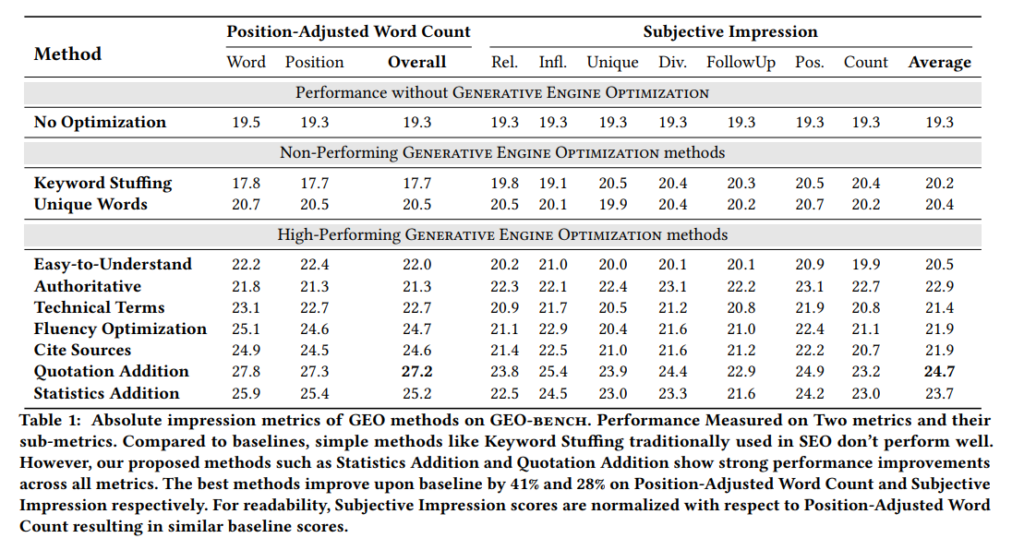
The researchers reported that GEO methods could improve source visibility by up to 40%, although results differed significantly depending on the type of query and domain. Strategies involving citations, relevant quotations, statistics, and improved presentation performed particularly well.
Traditional keyword stuffing didn’t.
To quote Aggarwal et al.:
“…our top-performing methods, Cite Sources, Quotation Addition, and Statistics Addition, achieved a relative improvement of 30-40% on the Position-Adjusted Word Count metric and 15-30% on the Subjective Impression metric.”
The researchers noted the improvements were from the addition of relevant statistics, authoritative quotes, and of course, adding verifiable and reliable citations sources. The changes, while minimal, significantly boosted AI visibility because it led to better credibility and richness of the said content.
GEO content doesn’t become better because you add the phrase “AI content optimization” seven more times. It becomes more useful when you improve the information available to the system.
That means answering the question directly, then explaining the reasoning, then supplying data, evidence, examples, sources, or expert context.
The effectiveness also appears to be context dependent. The GEO research found, for example, that statistics performed particularly well in some domains, while quotations were more useful in others.
In short: there won’t be one universal GEO content template.
Give Readers and Machines Information They Can’t Get Everywhere Else
This overlaps with another useful SEO concept: information gain. If five competing articles explain exactly the same thing, creating a sixth rewritten version adds very little.
You should ask:
What new information, perspective, experience, or original research does this page contribute?
That becomes even more important as AI makes generic explanatory content cheaper to produce.
A useful way to think about content value is:
Information gained ÷ effort required to obtain it.
Information-foraging research applied to search suggests people want useful information quickly and at low cognitive cost. The same practical principle helps machine extraction: direct answers, clear structure, specific terminology, ratings, reviews, evidence, and well-organized information reduce the effort required to understand a page.
So don’t just ask:
Is this optimized?
The question should be:
What will someone know after reading this that they wouldn’t know after reading the competing pages?
That’s also why I use content gap analysis before simply adding more copy. The goal is to identify missing questions, use cases, comparisons, or decision-making information competitors haven’t adequately covered.
Original data, customer research, firsthand experience, experiments, expert commentary, internal benchmarks, and strong case studies give you information competitors can’t easily reproduce.
Give AI a Reason to Justify the Recommendation
Clear positioning tells a system what you claim to be good at. Evidence helps establish whether that claim deserves weight.
That evidence might include customer reviews, quantified case studies, certifications, documented experience, original research, product specifications, credible third-party recognition, or expert credentials.
For a personal brand, even experience becomes more useful when connected to the buying situation.
For example:
I’ve written and edited more than 1.5 million words.
is evidence of experience.
But:
My food science and nutrition background helps me edit health and supplement content where weak sourcing or inaccurate claims create greater editorial risk.
…is more useful for recommendation.
It connects expertise to a specific customer, problem, mechanism, and reason for choosing the person. Your pages should effectively answer the machine’s selection interview:
What do you do? Who is it for? When are you a good fit? Why should someone believe you?
I’ve applied this more practically in a GEO and AI visibility case study, where I break down how I structure content around intent, relevance, and the information an AI system needs to select a page.
Get Other Sources to Reinforce the Same Story
Your website can explain why you’re good. It can’t independently confirm that everyone else agrees. That’s where off-page GEO becomes important.
Relevant signals can come from customer reviews, industry publications, podcasts, expert contributions, comparison pages, partner websites, newsletters, creators, directories, communities, events, and other third-party sources. The aim isn’t simply to accumulate mentions. It’s to accumulate relevant associations.
Compare:
Robert James Rivera contributed to this article.
with:
AI content strategist Robert James Rivera explains how human editing improves the credibility of AI-assisted SEO content.
The second establishes context:
Robert → AI content → editing → SEO → credibility
A backlink creates a path.
A contextual mention also creates an association.
The GEO material describes this broader environment as a network problem: on-page work establishes fitness, while off-page activity helps distribute those fitness signals through reviews, media, partnerships, communities, creators, and other sources.
But don’t turn that into another link-building numbers game.
Generative systems are black boxes. Citations are visible artifacts, not proof of the mechanism that caused a recommendation. Models change, retrieval changes, and outputs vary.
The goal is to make the public information surrounding your brand more accurate, relevant, credible, and consistent.
Run a Simple 20-Prompt GEO Audit
You don’t need an expensive GEO platform to begin. Take the 20 representative prompts you mapped earlier and run them across the AI systems relevant to your audience.
Record five things:
- Mention: Did your brand appear?
- Recommendation: Was it actually suggested as a solution?
- Accuracy: Did the system describe you correctly?
- Competition: Which brands repeatedly appeared beside or instead of you?
- Evidence: What reasons or sources seemed to support the answer?
Then look for patterns.
Maybe your brand appears for highly specific problems but disappears for broader category prompts. That’s probably different from appearing frequently but being described incorrectly. One suggests a fame or distribution problem. The other suggests an information or positioning problem.
This is why AI visibility, citations, recommendations, traffic, and revenue shouldn’t be treated as the same metric. The GEO framework recommends measuring recommendation performance and commercial influence rather than celebrating isolated screenshots.
GEO Isn’t a Citation Contest
Getting your brand mentioned by AI isn’t about discovering one secret LLM ranking factor.
- Start with the problems you genuinely solve.
- Map the prompts where you deserve consideration.
- Make your positioning unmistakable.
- Create content that contributes useful information instead of repeating what already exists.
- Back important claims with evidence.
- Get credible third parties to reinforce the same associations across the web.
The progression I’m interested in isn’t:
Content → citation.
It’s:
Understanding → evidence → recognition → consideration → recommendation.
Because being cited tells you an AI system used some information. Being recommended tells you your brand made the shortlist. That’s the GEO outcome businesses should ultimately care about.
FAQs
1. What should I fix first if my brand is not appearing in AI recommendations?
Start with one high-intent page. Check whether it clearly states who you serve, the problem, location or use case, and why you’re a fit. Then tighten headings, add direct answers, proof, and supporting sources. I used this approach on a Chicago law-firm page that reached Google’s top five and surfaced as a top ChatGPT recommendation for a related city query.
2. How can Reddit support GEO without turning into spam?
Start by searching Reddit for recurring comparison, complaint, alternative, and buying-decision queries in your category. Log the exact language people use, then contribute only where your product genuinely fits the discussion. I’ve used Reddit-driven strategies to support ChatGPT mentions and first-page visibility. The practical rule: match the thread’s intent first, add useful context second, and mention the brand only when it improves the answer.
3. How do I optimize an AI draft for SEO and GEO?
Use a five-pass edit: verify search intent, move the main answer higher, remove filler, strengthen weak claims with reliable sources, and add information competitors are missing. I’ve applied this process across more than 1.5M words of AI-assisted content. For McClatchy affiliate work, articles often reached the top three within a week and page one within a month.
References
Aggarwal, P., Murahari, V., Rajpurohit, T., Kalyan, A., Narasimhan, K., & Deshpande, A. (2024). GEO: Generative engine optimization. In Proceedings of the 30th ACM SIGKDD Conference on Knowledge Discovery and Data Mining (pp. 5–16). Association for Computing Machinery. https://doi.org/10.1145/3637528.3671900
Holland, A. (2024, May 9). Information gain: Here’s what this new SEO ‘buzzword’ really means. Search Engine Land. https://searchengineland.com/what-information-gain-seo-means-440326
Author
Robert James Rivera is an AI Content Strategist specializing in AI SEO and Generative Engine Optimization (GEO). He has written and humanized over 1,500,000 words of AI-assisted content, focusing on buyer intent, search visibility, and conversion-driven messaging. His work centers on helping brands become trusted sources within AI-driven search ecosystems, where visibility is determined by credibility, consistency, and contextual relevance.
Leave a Reply