
Last updated: April 2026
Why So Many People Are Turning to GLP-1 Drugs Right Now
For a lot of people, weight loss stops feeling simple after a while.
You lose some weight, then hunger picks up, cravings come back, and the body seems to fight back. As weight drops, appetite hormones can rise and energy expenditure can fall, which makes maintenance harder over time.
That’s a big reason GLP-1 drugs are drawing so much attention.
Semaglutide and tirzepatide change appetite signaling and slow digestion, so people feel full sooner and stay full longer. In trials, they’ve produced average weight loss of roughly 10% to 20%, far beyond what most non-surgical options achieve. Many users also report fewer cravings and less constant thinking about food.
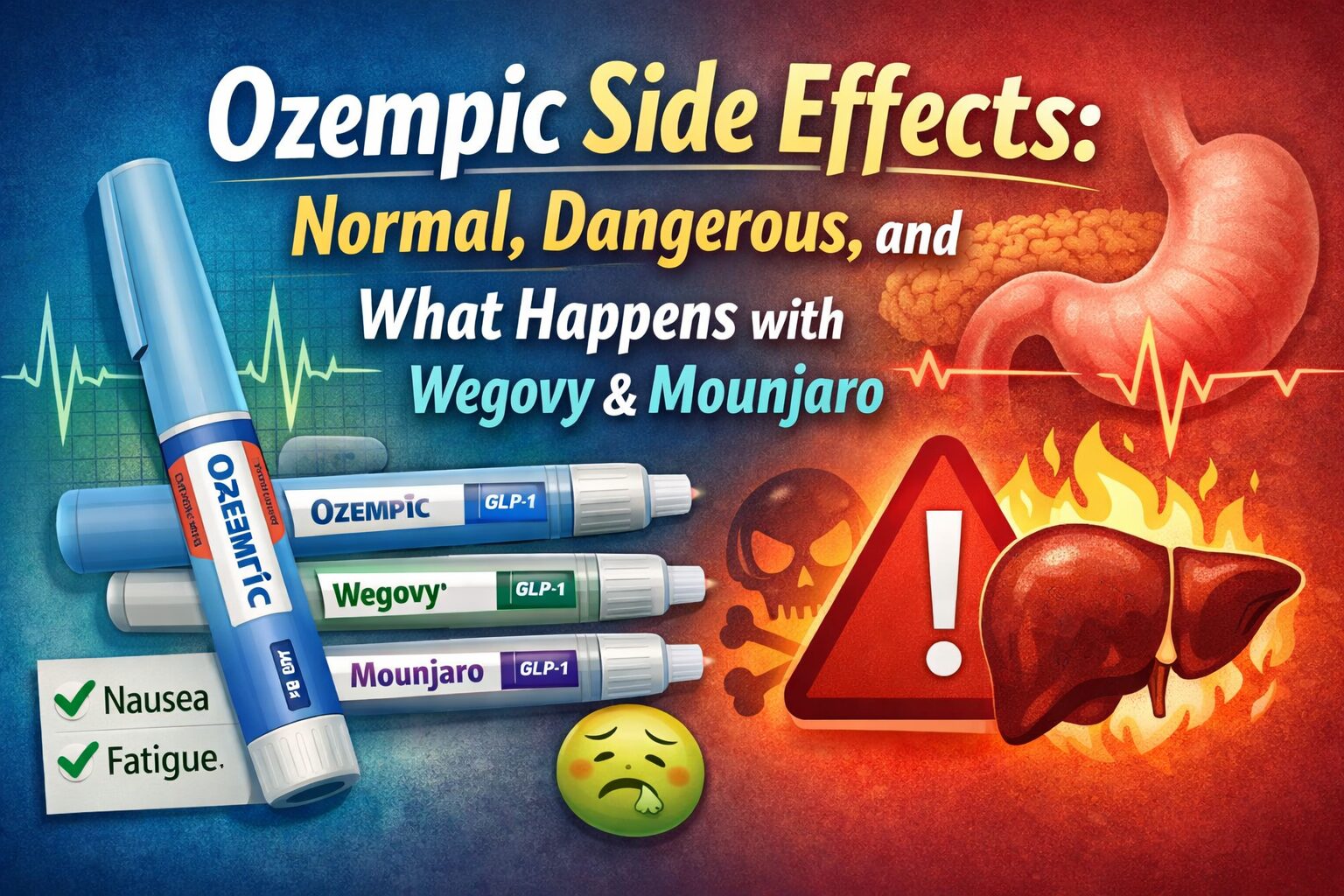
This guide explains common, serious, and long-term Ozempic side effects together with Wegovy and Mounjaro. It also includes what you can expect during use and what happens when you stop.
Quick Summary
- GLP-1 drugs like Ozempic, Wegovy, Mounjaro, and Zepbound can lead to 10% to 20% average weight loss by reducing appetite, slowing digestion, and lowering the constant pull to eat.
- Nausea, vomiting, diarrhea, constipation, and loss of appetite are common side effects. In trials, 40% to 70% of users report some digestive side effect.
- More serious risks include pancreatitis, gallbladder problems, dehydration-related kidney issues, and rare cases of severe delayed stomach emptying.
- Most side effects are dose-dependent, which means they are more likely during escalation or when people increase too quickly.
- In follow-up studies, people regained about 50% to 70% of lost weight within 1 year after stopping GLP-1 medication.
Why People Either Love or Regret GLP-1 (There’s Rarely an In-Between)
The response to GLP-1 drugs isn’t evenly distributed. It clusters at the extremes.
In clinical trials, average weight loss ranges from 10% to 20% of body weight, with some newer drugs pushing closer to 20–25% in certain groups. Those are strong outcomes. Enough to change blood sugar, cholesterol, even cardiovascular risk.
So on paper, the results look consistent. But real-world experience doesn’t follow a clean average.
Retention data shows the split more clearly.
Roughly 30% of patients stop within the first month, and by one year, only about 30–40% are still taking the medication. That drop-off isn’t random. It usually comes down to side effects, cost, or expectations not lining up with reality.
And that’s where the divide starts to show.
Some people experience a sharp reduction in appetite within the first few weeks. Caloric intake drops naturally, often by 20–30% without forced restriction. Cravings weaken. The constant pull toward food fades into the background.
For someone who’s dealt with persistent hunger signals for years, that kind of change isn’t subtle. It feels like control, or maybe relief. Something finally working with their biology instead of against it.
But that same mechanism (slowing digestion, altering appetite signaling) comes with tradeoffs.
In clinical data, up to 40–70% of users report gastrointestinal side effects, especially during dose escalation. Nausea is the most common. Vomiting, constipation, and diarrhea follow behind.
For many, it’s temporary. For others, it’s enough to stop.
And it doesn’t always stay physical. Large-scale social data analysis shows recurring reports of:
- insomnia
- anxiety
- mood changes
Not in the majority, but consistently present. Enough to matter.
Then there’s the adjustment phase.
Most protocols increase dosage every 4 weeks, moving from a low starting dose to a therapeutic range. That transition period is where side effects tend to spike. If the increase is too fast (or tolerance is low) the experience can shift quickly from manageable to overwhelming.
That’s where a lot of negative experiences come from. Not the drug itself, but how the body responds during escalation. So you end up with two very real outcomes:
One group experiences:
- reduced hunger
- steady weight loss
- manageable side effects
Another group hits:
- persistent nausea
- fatigue or low energy
- difficulty maintaining normal eating patterns
Same drug. Different response curves. And that difference isn’t obvious at the start. Which is why the experience feels unpredictable.
How GLP-1 Drugs Work (And Why Side Effects Happen)
GLP-1 drugs work by changing how your body handles hunger and digestion at a hormonal level. This is a more direct, medical approach, especially if you just want to lose 20 lbs naturally.
They mimic a natural hormone called glucagon-like peptide-1 (GLP-1), which is released after eating. This hormone signals fullness, slows stomach emptying, and helps regulate blood sugar.
That slowdown is key.
Food stays in the stomach longer, which increases satiety and reduces how often you feel the need to eat. At the same time, GLP-1 activity in the brain (particularly in appetite and reward centers) reduces cravings and food-driven impulses.
This combination leads to lower calorie intake, often without deliberate restriction.
But the same mechanisms create the side effects.
Slower gastric emptying increases the likelihood of nausea, bloating, and early fullness, especially during the first few weeks or after dose increases. The digestive system is adjusting to a new pace.
Appetite suppression can also overshoot. Some people eat too little, too quickly, which can lead to fatigue or discomfort.
So the tradeoff is built in.
The same biological changes that reduce hunger are the ones most likely to cause side effects, especially early on or at higher doses.
What Are the Most Common GLP-1 Side Effects?
Most side effects from GLP-1 drugs are gastrointestinal, especially early in treatment or after dose increases.
In clinical trials, 40% to 70% of users report at least one digestive symptom.
The most common:
- Nausea (up to ~40–50%)
- Diarrhea (10–20%)
- Vomiting (10–15%)
- Constipation (10–20%)
- Loss of appetite (common, varies by dose)
These aren’t random.
They come directly from how the drug works: slowing digestion and reducing food intake.
Table: Common GLP-1 Side Effects and Frequency
| Side Effect | Estimated Frequency | When It Happens Most |
|---|---|---|
| Nausea | 30–50% | Early / dose increase |
| Diarrhea | 10–20% | Early weeks |
| Vomiting | 10–15% | Dose escalation |
| Constipation | 10–20% | Ongoing |
| Appetite loss | Very common | Throughout |
When Do These Side Effects Start?
Most begin within the first 1–4 weeks.
That timing isn’t accidental.
GLP-1 drugs are introduced at a low dose, then gradually increased every few weeks. Each increase can trigger a new wave of symptoms as the body adjusts.
What “Mild” Side Effects Actually Feel Like
Clinically, many of these are labeled as mild to moderate.
In real terms, that can mean:
- feeling full after a few bites
- needing to stop meals early
- low-level nausea that comes and goes
For some, it fades. For others, it builds.
Key Pattern
Side effects are:
- dose-dependent
- most intense during escalation
- often temporary, but not always
That variability is what makes the experience hard to predict.
Side Effects People Don’t Expect (But Often Report)
Beyond the common digestive issues, there’s another layer that shows up less in clinical summaries, but consistently in real-world use.
These aren’t always listed as primary side effects, but they appear often enough to matter.
Changes in How Food Feels
Some people notice a shift that goes beyond appetite.
Food becomes less appealing. Not in a dramatic way, just muted. Meals feel smaller, sometimes mechanical. You eat because you should, not because you want to.
That’s tied to reduced activity in reward pathways, not just hunger signals.
Low Energy or “Off” Feeling
Calorie intake can drop quickly, sometimes 20–30% early on.
If intake falls faster than the body adjusts, energy can dip. Some describe it as fatigue, others as a vague “off” feeling during the first few weeks.
Sleep and Mood Changes
These are less common, but reported.
Patterns include:
- trouble sleeping
- increased anxiety
- mood shifts
Not universal, but consistent enough across large user datasets to be tracked.
Cold Sensitivity
Some people feel colder than usual.
This can happen with rapid weight loss and lower calorie intake, especially when body fat drops.
Digestive Patterns That Don’t Fit Neatly
Not all symptoms are straightforward.
Examples:
- alternating constipation and diarrhea
- bloating that comes and goes
- sulfur-like burps
These reflect changes in digestion speed and gut response.
Key Pattern
These effects tend to:
- appear early or during dose increases
- vary widely between individuals
- improve for some, persist for others
They’re not always severe, but they can affect daily life more than expected.
Serious Side Effects You Should Not Ignore
Most GLP-1 side effects are manageable.
A smaller group isn’t.
These are less common, but they matter because they can escalate quickly if ignored.
Pancreatitis (Inflammation of the Pancreas)
This is one of the most discussed serious risks.
It’s considered rare, but documented.
Symptoms tend to be distinct:
- persistent, severe abdominal pain
- pain that may radiate to the back
- nausea that doesn’t improve
This isn’t typical “medication nausea.” It’s more intense and doesn’t ease with time.
Gallbladder Issues (Gallstones)
Rapid weight loss increases the risk of gallstones.
That’s not specific to GLP-1 drugs, but these medications can accelerate weight loss enough to trigger it.
Warning signs:
- sharp pain in the upper right abdomen
- pain after eating fatty meals
- nausea or vomiting
Kidney Problems (Often Linked to Dehydration)
This usually doesn’t start as a kidney issue.
It starts with:
- prolonged vomiting
- low fluid intake
Over time, dehydration can strain kidney function, especially in people with existing risk factors.
When “Common” Side Effects Become a Problem
This is where most people get caught off guard.
Symptoms like nausea or reduced appetite are expected.
But they cross a line when they lead to:
- inability to keep food down
- ongoing vomiting
- very low calorie intake
- signs of dehydration (dizziness, weakness)
At that point, it’s no longer a mild side effect.
Key Pattern
Serious complications are rarely random.
They’re more likely when:
- dose increases happen too quickly
- hydration is low
- food intake drops too sharply
- underlying conditions are present
Gastroparesis and “Stomach Paralysis”: What You Need to Know
Gastroparesis is one of the most searched (and misunderstood) risks linked to GLP-1 drugs.
It sounds severe. And in some cases, it is.
What Is Gastroparesis?
Gastroparesis means delayed stomach emptying.
Food stays in the stomach longer than normal, sometimes much longer. GLP-1 drugs already slow this process, which is part of how they reduce appetite.
Gastroparesis is that effect pushed further.
Symptoms to Watch For
- persistent nausea
- vomiting undigested food
- feeling full after very small meals
- bloating or abdominal discomfort
The key difference is persistence. These symptoms don’t fade between doses or over time.
How Common Is It?
This is where clarity matters.
- Mild delayed gastric emptying is common (part of the drug’s mechanism)
- True gastroparesis is rare
Precise incidence is still being studied, but current data suggests:
- clinically significant cases occur in well under 1% of users
- most reported cases involve higher doses or pre-existing risk factors
So the risk exists, but it’s not typical.
Is Gastroparesis Permanent?
In most reported cases, no.
Symptoms often improve after:
- reducing the dose
- stopping the medication
That’s because the drug’s effect on stomach emptying is reversible.
However, there are exceptions.
Some cases take longer to resolve, especially if:
- symptoms were severe
- the condition went unrecognized for a while
- underlying digestive issues were already present
So while it’s usually temporary, it’s not something to ignore.
Why This Risk Gets So Much Attention
Two reasons:
- The symptoms overlap with common side effects early on
- The name itself “stomach paralysis” sounds extreme
That combination creates uncertainty.
People don’t always know:
- what’s expected
- what’s a warning sign
Practical Takeaway
Slower digestion is expected.
But if symptoms become:
- persistent
- worsening
- or disruptive to normal eating
That’s where it needs attention.
Do GLP-1 Drugs Cause Cancer? What the Evidence Actually Shows
This concern comes up often, mostly driven by headlines and ongoing lawsuits.
The short answer is:
There is no confirmed evidence that GLP-1 drugs cause cancer in humans.
There is a theoretical risk based on earlier animal studies.
Where the Cancer Concern Comes From
In preclinical studies, rodents given GLP-1 drugs developed thyroid C-cell tumors.
That finding led to:
- FDA-required warnings
- contraindications for people with medullary thyroid cancer (MTC) or MEN2 syndrome
But rodent biology is different.
Humans have far fewer GLP-1 receptors in thyroid C-cells, which makes the same effect much less likely to translate directly.
What Human Data Shows
So far:
- Large clinical trials and post-marketing data have not demonstrated a clear increase in thyroid cancer rates
- Ongoing studies are still monitoring long-term outcomes
That’s important.
Absence of evidence is not proof of zero risk, but current data does not support a causal link.
What About Pancreatic Cancer?
This is another common concern.
Earlier observational signals raised questions, but more recent and larger analyses have not confirmed a consistent association between GLP-1 drugs and pancreatic cancer.
The data here is considered inconclusive but not alarming.
Why Lawsuits Exist
Lawsuits are often cited as “proof” of risk.
They are not.
Most current cases focus on:
- gastroparesis
- severe gastrointestinal complications
- cancer claims based on theoretical risk
Legal claims reflect allegations, not verified medical conclusions.
Where Misinformation Comes From
A few patterns drive confusion:
- Animal studies reported as human risk
- Rare adverse events presented without context
- Lawsuits interpreted as scientific validation
These distort the actual evidence.
Who Should Be Cautious
GLP-1 drugs are not recommended for people with:
- personal or family history of medullary thyroid cancer
- multiple endocrine neoplasia type 2 (MEN2)
This is a precaution based on biological plausibility, not confirmed widespread harm.
Practical Takeaway
- Cancer risk is theoretical in some areas, unproven in others
- Current human data does not show a clear causal link
- Monitoring is ongoing, especially for long-term use
The risk discussion is real, but often overstated outside clinical context.
What Actually Happens in Real Life (Beyond Clinical Trials)
Clinical trials show what can happen.
Real-world data shows what usually does.
And the gap between the two is where most confusion comes from.
Dropout Rates Are High and Early
Across multiple datasets:
- Around 30% of users stop within the first 4 weeks
- By 3 months, discontinuation rates can reach 50% or higher
- After 1 year, only about 30–40% remain on the medication
That’s a steep drop.
The reasons are consistent:
- side effects
- cost
- expectations not matching reality
Weight Loss Is Real, but Not Evenly Distributed
In trials:
- average weight loss sits around 10–20%
- some reach 20–25% at higher doses
In real use:
- results vary widely
- some lose steadily
- others plateau early or stop due to tolerance issues
Adherence plays a major role.
Side Effects Drive Most Early Drop-Off
Gastrointestinal symptoms account for a large share of discontinuation.
Even when labeled “mild,” they can interfere with:
- eating normally
- daily routine
- energy levels
That friction adds up quickly.
Cost Is a Major Limiting Factor
In the U.S.:
- Monthly cost can range from $900 to $1,300+ without insurance
- Coverage is inconsistent, especially for weight loss use
Even motivated users stop if access becomes unstable.
The Expectation Gap
This is less measurable, but just as important.
Some expect:
- rapid, effortless weight loss
- minimal side effects
What they experience instead:
- gradual dose increases
- adjustment periods
- tradeoffs between results and tolerance
That gap drives a lot of early exits.
Key Pattern
Success with GLP-1 drugs tends to follow a pattern:
- gradual dose escalation
- manageable side effects
- consistent use over time
When one of those breaks, outcomes change.
What Happens When You Stop GLP-1 Drugs?
This is one of the most important (and least explained) parts of using GLP-1 medications.
The short version:
Weight regain is common. And it can happen faster than expected.
What the Data Shows
In clinical follow-ups after stopping semaglutide:
- Participants regained ~50% to 70% of lost weight within 1 year
- Most of that regain started within the first 3–6 months
That timeline matters.
The effect doesn’t slowly fade; it reverses relatively quickly.
Why Weight Comes Back
GLP-1 drugs don’t permanently reset metabolism.
They actively suppress appetite and slow digestion while you’re taking them. Once stopped:
- hunger signals return
- gastric emptying normalizes
- calorie intake increases
In many cases, appetite rebounds above baseline for a period.
What People Actually Notice
The shift tends to follow a pattern:
Weeks 1–4 after stopping:
- appetite starts increasing
- portion sizes grow
Months 1–3:
- cravings return more consistently
- weight regain begins
Months 3–12:
- gradual regain continues
- often stabilizes below starting weight
How Much Weight Comes Back?
It varies, but trends are consistent:
- Many regain at least half of what they lost
- Some return close to baseline
- A smaller group maintains most of the loss (usually with strong lifestyle changes)
The Key Factor: What Replaces the Drug
Outcomes depend heavily on what happens after stopping:
- No structure → faster regain
- Nutrition + activity changes → slower regain
- Continued medical support → better long-term stability
What This Means in Practice
GLP-1 drugs often function more like long-term treatments than short-term fixes. Stopping isn’t neutral; it changes the system back.
Psychological and Behavioral Effects of GLP-1
The effects of GLP-1 drugs don’t stop at appetite.
They extend into behavior, mood, and how people relate to food day to day.
Reduced Cravings and “Food Noise”
One of the most consistent effects is a drop in cravings.
In studies and large-scale user reports, people describe eating less without forcing it. Calorie intake often falls by 20–30% early in treatment, driven by reduced hunger signals and changes in brain reward pathways.
GLP-1 activity affects areas linked to dopamine.
That matters.
Food becomes less stimulating. The urgency fades. Some people describe it as “quiet”; fewer intrusive thoughts about eating, fewer impulsive decisions around food.
Changes Beyond Food
This effect doesn’t always stay limited to eating.
There are growing reports of reduced interest in:
- alcohol
- highly processed foods
- compulsive habits
The mechanism isn’t fully mapped, but it likely ties to reward system modulation, not just appetite suppression.
Mood and Sleep Changes
This is where the experience becomes less predictable.
Some report:
- improved mood
- less emotional eating
Others report:
- anxiety
- insomnia
- feeling mentally “off”
Large-scale social data shows these patterns recurring, even if they don’t affect the majority.
When the Shift Feels Too Strong
In some cases, appetite suppression goes beyond comfort.
People may:
- forget to eat
- struggle to meet protein or calorie needs
- feel disconnected from normal hunger cues
That can lead to:
- fatigue
- low energy
- difficulty maintaining routine
Social and Identity Effects
This part is rarely discussed, but it shows up often.
As eating patterns change, so does behavior around:
- social meals
- routines
- self-image
Some feel more in control. Others feel out of sync, especially when appetite doesn’t match social expectations.
Key Pattern
These effects tend to:
- appear early, often within weeks
- intensify with higher doses
- vary widely between individuals
What This Means
GLP-1 drugs don’t just reduce how much you eat. They change how eating feels, and in some cases, how reward and motivation are processed more broadly. For some, that’s a benefit. For others, it takes adjustment.
Hidden Risks Most People Don’t Expect with GLP-1
Weight loss from GLP-1 drugs isn’t purely fat loss.
It’s a mix.
Clinical and review data show that during rapid weight loss:
- ~20% to 40% of total weight lost can come from lean mass (muscle)
- In some cases, especially with low protein intake, that number can go higher
That’s not unique to GLP-1, but the speed of weight loss can amplify it.
Muscle Loss (Sarcopenia Risk)
If someone loses 20 lbs, roughly:
- 4–8 lbs may come from muscle
That matters.
Muscle supports:
- metabolism
- strength
- long-term weight maintenance
Losing too much can:
- slow metabolic rate
- increase fatigue
- make regain more likely later
Bone Density Changes
Rapid weight loss is also linked to reduced bone mineral density.
Data suggests:
- measurable bone loss can occur within 6–12 months of significant weight reduction
This risk increases when:
- resistance training is absent
- protein intake is low
Weight Cycling (Lose → Regain Pattern)
From earlier data:
- Many regain 50–70% of lost weight within 1 year after stopping
When that cycle repeats:
- body composition worsens
- fat regain often exceeds muscle regain
Over time, this can shift the body toward:
- higher fat percentage
- lower lean mass
Why This Gets Overlooked
Most attention stays on:
- total weight lost
Less attention goes to:
- what kind of weight is lost
But composition matters more than the number alone.
Key Pattern
These risks increase when:
- weight loss is rapid
- protein intake is low
- strength training is absent
- the drug is used without a long-term plan
What This Means in Practice
GLP-1 drugs can be effective for weight loss, but without support (nutrition, resistance training), the outcome isn’t always optimal. You can lose weight and still lose things you want to keep.
The Hidden Risk: Using GLP-1 Incorrectly
A large share of complications tied to GLP-1 drugs don’t come from the drug alone.
They come from how it’s used.
Skipping the Titration Process
GLP-1 drugs are designed to start low and increase gradually over time.
Typical protocols step up doses every 4 weeks.
When that process is rushed (or skipped entirely) side effects increase sharply:
- nausea becomes persistent
- vomiting becomes more likely
- tolerance doesn’t develop properly
This is one of the most common avoidable mistakes.
Self-Adjusting Doses
Some users increase doses early, thinking it will speed up weight loss.
It doesn’t work that way.
Higher doses are associated with:
- higher rates of GI side effects (up to ~70%)
- greater risk of dehydration
- lower adherence overall
The result is often the opposite of what’s intended, people stop sooner.
Using GLP-1 Without Medical Oversight
This is where risk increases the most.
Examples include:
- buying from unverified or compounded sources
- using without screening for contraindications
- combining with other medications without guidance
Certain risks (pancreatitis or severe GI reactions) are more likely to be missed early without proper monitoring.
Not Adjusting Diet or Hydration
GLP-1 drugs reduce appetite.
If intake drops too far:
- protein becomes insufficient
- hydration falls
- electrolyte balance shifts
That can lead to:
- fatigue
- dizziness
- worsening side effects
Ignoring Early Warning Signs
This is the most dangerous pattern.
People expect discomfort, so they push through symptoms that shouldn’t be ignored:
- ongoing vomiting
- inability to eat
- severe abdominal pain
At that point, the issue isn’t tolerance, but escalation.
Key Pattern
Misuse tends to follow a pattern:
- trying to accelerate results
- underestimating side effects
- delaying adjustments when symptoms worsen
That combination increases risk quickly.
What This Means
GLP-1 drugs can be used safely.
But they are not low-effort or “set and forget.”
How they’re used determines how they’re experienced.
Who Should Be More Careful with GLP-1 Drugs
GLP-1 drugs aren’t appropriate for everyone.
Some people should avoid them entirely. Others can use them, but with closer monitoring and clearer boundaries.
Who Should Avoid GLP-1 Drugs
These are established contraindications or high-risk groups:
- Personal or family history of medullary thyroid cancer (MTC)
- Multiple endocrine neoplasia type 2 (MEN2)
- History of severe allergic reaction to GLP-1 medications
These aren’t gray areas. They’re listed directly in prescribing guidance.
Who Should Use Caution
This group is larger and more relevant to most readers.
People with Gastrointestinal Conditions
- history of gastroparesis
- chronic severe reflux
- inflammatory bowel issues
Since GLP-1 slows digestion, symptoms can worsen.
People with a History of Pancreatitis
- GLP-1 drugs are not proven to cause pancreatitis consistently
- but prior history increases concern
Monitoring is important here.
People with Eating Disorders (Past or Present)
This is often overlooked.
GLP-1 suppresses appetite strongly. In someone with:
- binge eating history
- restrictive patterns
It can shift behavior in unpredictable ways.
People Using It Without Medical Oversight
Even without a medical condition, risk increases when:
- doses are not monitored
- side effects are ignored
- contraindications aren’t screened
This overlaps with misuse, but it’s common enough to call out directly.
People with Low Body Weight or “Cosmetic” Use
These drugs were developed for:
- obesity
- metabolic disease
Using them outside those contexts increases the chance of:
- excessive weight loss
- muscle loss
- nutritional deficiencies
Key Distinction
There’s a difference between:
- “Higher risk but manageable”
- “Should not be used”
Blurring that line creates problems.
What This Means
GLP-1 drugs are effective, but they’re not neutral.
The baseline matters:
- medical history
- current health
- how the drug is used
That’s what determines whether the experience stays controlled or becomes difficult to manage.
How to Reduce Side Effects and Use GLP-1 More Safely
There are ways to lower the odds of a bad experience.
None of them make the drug risk-free. They do make it easier to tolerate, and easier to stop problems before they grow.
1. Start with the actual starter dose
This sounds obvious, but a lot goes wrong here.
Semaglutide usually begins at 0.25 mg weekly. Tirzepatide usually begins at 2.5 mg weekly. Those are not full treatment doses. They are tolerance doses.
The point is to let the body adjust.
Starting higher, or restarting at a dose you used months ago, is one of the fastest ways to trigger nausea, vomiting, and early dropout.
2. Stay on each dose long enough
Most standard titration schedules increase every 4 weeks.
That spacing matters. It gives the stomach, appetite signals, and daily routine time to settle. Some people need longer, not shorter. If side effects are still active near the end of a dosing block, pushing up too soon usually makes things worse.
3. Treat hydration like part of the prescription
A lot of serious problems begin with low intake.
If appetite drops sharply, fluid intake often drops too. Then constipation, dizziness, headaches, fatigue, and kidney strain start stacking up. A practical target is steady fluid intake through the day, not trying to “catch up” at night.
If vomiting or diarrhea shows up, hydration becomes even more important.
4. Keep protein intake deliberately high
This is one of the biggest protection steps.
GLP-1 drugs can cut appetite enough that people under-eat without realizing it. That raises the risk of muscle loss. Clinical reviews suggest that 20% to 40% of total weight lost can come from lean mass during aggressive weight loss.
Protein helps blunt that.
The goal is not perfection. It’s consistency. Build meals around protein first, then add the rest.
5. Eat smaller meals and slow down
Large meals tend to backfire on these drugs.
The stomach is emptying more slowly. Heavy meals, greasy meals, and eating too fast increase the odds of nausea, bloating, reflux, and vomiting. Small meals work better. Lower-fat meals often work better too, especially early on.
If you feel full, stop there. Pushing past fullness usually gets punished.
6. Watch the first 1 to 4 weeks closely
That window matters most.
A lot of common side effects begin in the first 1–4 weeks, and a new round can happen after each dose increase. This is the period where mild symptoms can either settle down or start building into something harder to manage.
It helps to track:
- nausea
- bowel changes
- food intake
- hydration
- energy
- sleep
Patterns are easier to catch when you’re looking for them.
7. Know the line between expected and unsafe
Expected:
- mild nausea
- earlier fullness
- constipation that responds to fluids or fiber
- a short adjustment phase after a dose increase
Unsafe:
- repeated vomiting
- inability to keep fluids down
- severe abdominal pain
- faintness, weakness, or signs of dehydration
- symptoms that keep getting worse instead of leveling out
This is where people get themselves into trouble. They assume everything is “just part of it” and wait too long.
8. Do not improvise with dose changes
Do not double up a missed dose to “catch up.”
Do not increase early because weight loss feels slow.
Do not restart at your old high dose after time off.
Those choices create a lot of the bad outcomes people blame entirely on the drug.
9. Plan for social eating and disrupted routine
A lot of people think only about the injection.
They don’t think about birthdays, restaurant meals, travel, long workdays, drinking less water, skipping meals, or eating too late. Then symptoms hit in situations where they’re harder to manage.
Have a simple default:
small meal, slower pace, water first, stop early.
That covers a lot.
10. Use the drug as part of a structure, not as the whole structure
The people who do best usually have a few things in place:
- a realistic titration pace
- enough protein
- enough fluid
- some form of resistance training
- a plan for what happens if side effects rise
That last part matters.
GLP-1 drugs work best when they’re treated like long-term medical therapy, not like a shortcut. The goal is not to force weight off fast. The goal is to get results you can still live with six months later.
Ozempic vs Wegovy vs Mounjaro vs Zepbound: Side Effects Compared
All four drugs work through similar pathways.
But they’re not identical, and the differences show up in dose, intensity, and tolerance.
The Core Difference
- Ozempic / Wegovy → semaglutide (GLP-1 only)
- Mounjaro / Zepbound → tirzepatide (GLP-1 + GIP dual action)
That second pathway (GIP) is part of why tirzepatide tends to produce greater weight loss, often in the 15–25% range in trials.
It also changes how some people experience side effects.
Table: Side Effects Comparison
| Drug | Active Ingredient | Typical Max Dose | Weight Loss (Avg) | GI Side Effects |
|---|---|---|---|---|
| Ozempic | Semaglutide | 2.0 mg | ~10–15% | Common |
| Wegovy | Semaglutide | 2.4 mg | ~15–20% | Common–Moderate |
| Mounjaro | Tirzepatide | 15 mg | ~15–22% | Moderate |
| Zepbound | Tirzepatide | 15 mg | ~15–25% | Moderate |
Gastrointestinal Side Effects
Across all four:
- Nausea remains the most common
- Rates can reach 30–50% depending on dose
- Vomiting and diarrhea typically fall in the 10–20% range
Tirzepatide (Mounjaro/Zepbound):
- Slightly higher efficacy
- Similar or slightly higher GI burden at higher doses
Semaglutide (Ozempic/Wegovy):
- More established safety data
- Often slightly more predictable tolerance curve
Dose Matters More Than Brand
A key point that gets missed:
Side effects are driven more by dose level and escalation speed than the specific drug name.
For example:
- Low-dose tirzepatide → often well tolerated
- High-dose semaglutide → can produce strong side effects
So comparisons only make sense within similar dose ranges.
Tolerance and Dropout Patterns
Across both drug types:
- Side effects peak during dose increases
- Most discontinuation happens in the first 1–3 months
- Long-term tolerance improves for many
Retention patterns are similar across drugs:
- ~30–40% remain at 1 year
Choosing Between Them (Practically)
The decision usually comes down to:
- Efficacy vs tolerance
- Access and cost
- how your body responds early on
There isn’t a universally “easier” option.
Key Takeaway
All four drugs share the same core tradeoff:
- Strong appetite and weight effects
- Dose-dependent side effects
The difference is how far each pushes those effects and how well you tolerate them.
Frequently Asked Questions About GLP-1 Side Effects
These are the questions people keep coming back to, usually after a few days or weeks on the drug, when the experience becomes real.
1. Why do I feel weird on Ozempic even when I’m not “sick”?
This comes up a lot. It’s usually a mix of:
- reduced calorie intake (often down 20–30% early)
- slower digestion
- shifts in blood sugar and energy
You’re not necessarily ill. Your body is adjusting to a different baseline. That “off” feeling tends to show up most in the first few weeks or after dose increases.
2. Is it normal to lose interest in food completely?
Up to a point, yes. GLP-1 drugs reduce both hunger and food-related reward signals. That can make food feel less appealing, sometimes noticeably so.
The issue is when it goes too far:
- skipping meals entirely
- struggling to meet basic nutrition
At that point, it’s no longer just appetite control.
3. Why do I feel worse when I increase my dose?
Because side effects are dose-dependent. Each increase (usually every 4 weeks) pushes the same mechanisms further:
- slower digestion
- stronger appetite suppression
That’s why symptoms often spike right after a dose change, then settle, if the body adapts.
4. Do GLP-1 side effects go away over time?
For many people, yes. Common side effects like nausea and digestive changes often improve within:
- 2–8 weeks, depending on the dose
But not always. A portion of users continue to experience symptoms long-term, which is one reason only ~30–40% remain on the drug after 1 year.
5. What happens if I stop taking Ozempic or similar drugs?
In most cases:
- appetite returns within weeks
- weight regain begins within 1–3 months
- about 50–70% of lost weight can return within a year
That doesn’t happen to everyone, but it’s the dominant pattern in the data.
The Bottom Line: Is GLP-1 Worth It for You?
There isn’t a single answer here. The data points in different directions, depending on what you value, and what you’re willing to manage.
On one side, the results are clear. Average weight loss of 10–20%, sometimes higher. Appetite drops. Cravings ease. For some, that shift alone changes how daily life feels.
On the other side, the tradeoffs are just as real. Side effects affect up to 40–70% of users in some form. Around 50% stop within a few months, and only 30–40% continue after a year. If you stop, 50–70% of the weight can return within 12 months.
That’s the range.
Some people find it manageable. The structure works, the side effects settle, and the results hold as long as they stay consistent.
Others hit friction early: dose increases feel rough, eating becomes difficult, or the experience just doesn’t fit into daily life the way they expected.
Most don’t know which group they’ll fall into at the start.
So the decision usually comes down to a few things:
- how much the current situation is affecting you
- how comfortable you are with the tradeoffs
- how willing you are to manage the process, not just take the medication
GLP-1 drugs can work. That part is established.
The harder question is whether the way they work (and what comes with it) fits what you’re looking for long term.
References
- Wilding JPH, Batterham RL, Calanna S, et al.
Once-weekly semaglutide in adults with overweight or obesity. N Engl J Med. 2021;384(11):989–1002. - Jastreboff AM, Aronne LJ, Ahmad NN, et al.
Tirzepatide once weekly for the treatment of obesity. N Engl J Med. 2022;387(3):205–216. - Rubino D, Abrahamsson N, Davies M, et al.
Effect of continued weekly subcutaneous semaglutide vs placebo on weight loss maintenance. JAMA. 2021;325(14):1414–1425. - U.S. Food and Drug Administration (FDA).
Ozempic (semaglutide) injection, prescribing information. FDA; 2023. - U.S. Food and Drug Administration (FDA).
Wegovy (semaglutide) injection, prescribing information. FDA; 2023. - U.S. Food and Drug Administration (FDA).
Mounjaro (tirzepatide) injection, prescribing information. FDA; 2023. - Wharton S, Astrup A, Endahl L, et al.
Estimating treatment effects of semaglutide and tirzepatide in obesity. Obesity (Silver Spring). 2023. - ICER (Institute for Clinical and Economic Review).
Medications for obesity management: effectiveness and value. ICER; 2022. - American Gastroenterological Association.
GLP-1 receptor agonists and gastrointestinal adverse effects. Gastroenterology. 2023. - Singh S, Wright EE, Kwan AY, et al.
Glucagon-like peptide-1 receptor agonists and risk of pancreatitis and pancreatic cancer. Diabetes Care. 2020. - Nauck MA, Meier JJ.
Management of endocrine disease: GLP-1 receptor agonists and safety. Eur J Endocrinol. 2019;181(5):R211–R234. - Davies MJ, Bergenstal R, Bode B, et al.
Efficacy of liraglutide for weight management. N Engl J Med. 2015;373:11–22. - StatPearls Publishing.
Glucagon-Like Peptide-1 Receptor Agonists. StatPearls. Updated 2024. - Australian Prescriber.
Safety considerations with GLP-1 receptor agonists. Aust Prescr. 2023. - Canadian Agency for Drugs and Technologies in Health (CADTH).
Clinical review of semaglutide and tirzepatide for obesity. CADTH; 2023. - Dhananjoy Datta, et al.
GLP-1 receptor agonists and mental health outcomes: social media–based analysis. 2024.
Author
Robert James Rivera is an AI Content Strategist specializing in AI SEO and Generative Engine Optimization (GEO). He has written and humanized over 1,000,000 words of AI-assisted content, focusing on buyer intent, search visibility, and conversion-driven messaging. His work centers on helping brands become trusted sources within AI-driven search ecosystems, where visibility is determined by credibility, consistency, and contextual relevance.
Connect with him here:
LinkedIn: https://www.linkedin.com/in/anima9/
Upwork: https://www.upwork.com/freelancers/~01fc10feac5776ee21
Leave a Reply